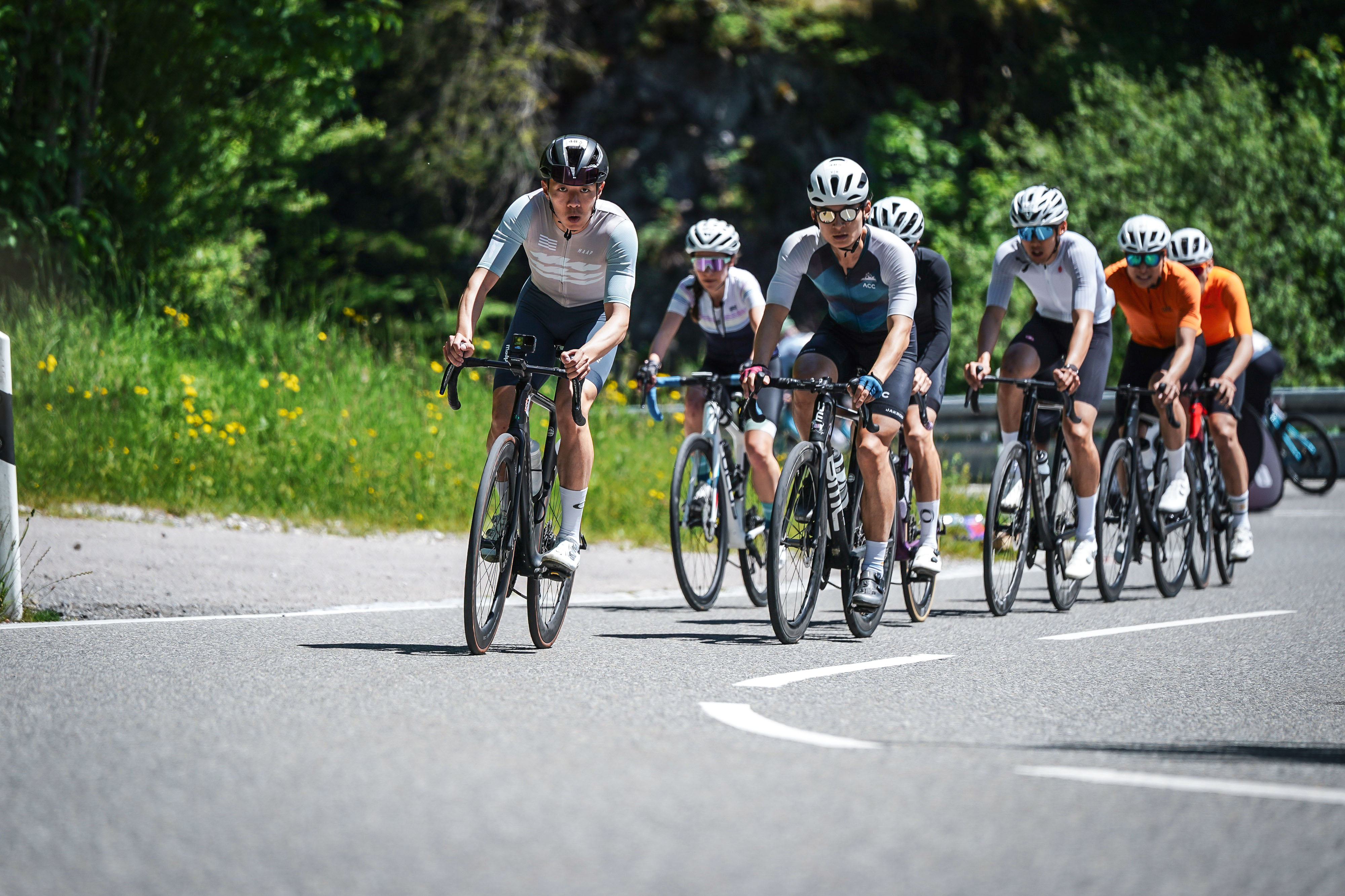
Riding alone, you’re only responsible for yourself. Riding in a group, everyone behind you depends on your movements being predictable.
That’s the core principle of group riding — every other rule follows from it:
Stay predictable. Never make a move the rider behind you can’t react to in time.
1. Hard limits
The following rules have no exceptions. Most groups treat them as zero-tolerance — a violation gets called out on the spot, and repeated violations get you pulled from the ride:
1. Never overlap wheels
Overlapping means your front wheel and the rear wheel of the rider ahead of you occupy the same lateral space. It’s the single leading cause of crashes in group rides.
The mechanics are simple: if the rider ahead shifts sideways even a few dozen centimeters for any reason (avoiding a pothole, dodging something, normal drift), they’ll clip your front wheel from the side. A front wheel hit from the side loses balance instantly — you almost never save it, and you typically go down toward the inside of the group, taking other riders with you.
The rider ahead has no idea and can’t do anything about it, because they can’t see you. Avoiding overlap is 100% the responsibility of the rider behind.
2. No emergency braking
A hard brake in a group triggers a chain reaction. When you need to slow down:
- First, coast without pedaling, or sit up slightly for more wind resistance
- If you must brake, do it gently and progressively, calling “slowing” behind you
- Only brake hard in a genuine emergency
This applies especially to whoever’s leading: never brake hard while leading the group. Look ahead and slow down early.
3. Always pass on the left
Passing on the right is a hard no — the right side is a blind spot for the rider ahead, and it’s also where the curb and pedestrians are.
After passing, don’t cut back in immediately. Confirm you’re fully clear (you should be able to see the rider you passed in your peripheral vision behind you) before merging smoothly back.
4. Always check over your shoulder before changing lanes or merging
Mirrors and peripheral vision are no substitute for an actual shoulder check, paired with a hand signal.
2. Hand signals and calls
A group communicates through hand signals and verbal calls. Every signal has to be passed rider-to-rider down the line — the people at the back need the information most and can see the road least.
Common hand signals
| Signal | Motion | Meaning |
|---|---|---|
| Stop | Raise a flat, open palm above the shoulder | Group needs to stop ahead |
| Slow down | Palm facing down, small up-down wave | Group needs to slow ahead |
| Pothole / obstacle | Point downward toward the hazard, on the side it’s on | A hole, drain cover, or debris on that side of the road |
| Gravel / loose surface | Hand out to the side, fingers spread and lightly shaken | Loose surface ahead, watch your grip |
| Turning left / right | Extend the arm on that side straight out | About to turn |
| Move over / single file | Hand behind your back, pointing in the direction the group should shift | Formation needs to narrow |
| Vehicle / pedestrian ahead | Hand behind your back, waving inward | Hazard on that side, move in |
Common verbal calls
Hand signals get blocked by bodies in a group, so critical information has to be called out at the same time:
“Stopping!” “Slowing!” “Hole!” “Car back!” (vehicle approaching from behind) “Car up!” (vehicle ahead or oncoming) “Single file!“
3. Formation
Single file is the default formation — use it on narrow roads, in heavy traffic, in poor visibility, on climbs and descents, and through intersections.
Two abreast works on wide, quiet roads at a steady flat-road pace. For the legal basis, see German Traffic Rules for Cyclists:
- 16 riders or more can form a closed formation (Verband) under StVO §27 and legally ride two abreast
- 15 or fewer falls under §2(4): side by side only when it doesn’t obstruct traffic
When riding two abreast, the two riders should stay level with each other, shoulder to shoulder — not staggered front-to-back, which eats into the space available for riders behind.
Clearing intersections
- Cross as a group, don’t let it split. If the whole group can’t make it through, the front half should slow and wait somewhere safe
- Shift to single file before the intersection, then reform afterward
- Every rider is responsible for judging the intersection for themselves — don’t blindly follow the rider ahead of you. Them making it through doesn’t mean you will, especially on a yellow light
4. Following distance
How much distance
| Situation | Distance |
|---|---|
| Beginners / mixed group | 1–2 bike lengths (roughly 2–4 m) |
| Experienced group, flat cruising | Half a wheel to one wheel |
| Downhill | Noticeably more — 2–3 bike lengths |
| Wet roads | Double whatever the base distance would otherwise be |
Look further ahead
The most common beginner mistake is fixating on the rear wheel right in front of you. That leaves you only able to react to that one rider’s movements, and the reaction is inherently late.
The right approach: look past the rider ahead of you, toward the next 3–5 riders, and use your peripheral vision to hold your distance from the one directly in front. That way you see road conditions almost as soon as the riders at the front do, instead of the information trickling back rider by rider.
5. Rotation
Rotation is how a group shares the wind resistance evenly. After a turn at the front, a rider falls back and the next one takes over.
Basic process
- Whoever’s leading takes a pull (30 seconds to 2 minutes for beginner groups — don’t overdo it)
- Signal behind you (flick an elbow out or call it), then pull off smoothly to the side
- Keep pedaling, don’t slow down — easing off naturally lets you drift back. Braking hard causes rear-end collisions
- Drop back along the side of the group, check behind you, and merge back in
Rotation direction
Rotation direction isn’t fixed — it depends on the wind: the leeward side is the side you drop back on. That way the rider dropping back gets more wind resistance and falls back more naturally, while the advancing line stays sheltered.
With no wind or an unclear wind direction, both directions are used in practice — there’s no absolute right answer.
What matters is that the whole group uses the same direction. Settle it before you set off — two riders moving in opposite directions collide head-on, which is genuinely dangerous.
Notes for beginners
- You don’t have to rotate the first time you join a group ride. Sit in the back half and let people know beforehand
- Don’t accelerate when you take a pull. A lot of beginners unconsciously push harder once they’re at the front, which ends up stringing the group out
- If it’s getting hard, just sit out a rotation — signal behind you and let someone else take over. Nobody thinks less of you for it. Blowing up the group is the actual problem
Next steps
- Pre-ride checks → Gear List and the ABC Quick Check
- Legal basis → German Traffic Rules for Cyclists
- Riding technique → Cadence, Shifting, and Braking: Three Core Riding Skills
Comments
Join with GitHub or email